

| In her first results briefing since taking the helm of Yangzijiang Financial three months ago, Executive Chairman Liu Hua's message was: the pain of recent provisions is a necessary clearing of the decks to prepare for a more diversified, Southeast Asian-focused future. YZJ Financial, which spun off its maritime business into Yangzijiang Maritime, reported a S$5.2 million loss for FY25. It recognised a massive S$290.9 million in provisions which aggressively wrote down legacy non-performing real estate debts in China.  YZJ Financial Executive Chairman Liu Hua at FY25 results briefing: She was previously CFO of YZJ Shipbuilding, then moved on to be Deputy CEO and CFO of YZJ Financial. YZJ Financial Executive Chairman Liu Hua at FY25 results briefing: She was previously CFO of YZJ Shipbuilding, then moved on to be Deputy CEO and CFO of YZJ Financial. YZJ Financial plans to accelerate liquidating such assets to channel money into growth as holding onto these bad assets incurs an opportunity cost. If this one-off provision is excluded, the company's core investment portfolio actually generated a positive return of $92.2 million in FY25. Following its separation from shipbuilding and maritime operations in Nov 2025, YZJ Financial currently manages a portfolio valued at $1.71 billion. |
Timeline for how YZJ Financial evolved:
|
Date |
Event |
Description |
|
28 Apr 2022 |
YZJ Shipbuilding (YZJS) spins off YZJ Financial (YZJFH) |
YZJS listed YZJFH on the SGX Mainboard by way of introduction. Shareholders received one YZJFH share for every YZJS share held. |
|
17 Nov 2025 |
YZJFH Distribution in Specie |
YZJFH distributed shares in YZJ Maritime to shareholders on a one-for-one basis. |
|
18 Nov 2025 |
YZJ Maritime (YZJM) debut |
YZJ Maritime began trading with an initial market cap of S$2.0 billion. |
The Investment Merits: A "Strengthened" Clean Slate
Despite the headline loss, Ms Liu reiterated that the company’s underlying fundamentals are more robust than they appear.
“The recognition of FY2025 allowances reflects prevailing market conditions,” she stated.
Ms. Liu said the company's road map centers on its transition from a China-heavy debt player to a diversified asset manager with a strong balance sheet.
She emphasized two key pillars for future value:
Capital Agility: Ms Liu highlighted that the company now operates with “zero external borrowings,” providing a level of safety rare in the financial sector.
Diversified Earnings: The goal is not chasing high-yield Chinese debt but “building a more resilient and diversified earnings base over time” through disciplined redeployment into Southeast Asia and public equities.
Geographically, YZJ Financial aims to achieve a 50:50 allocation between China and Asia Pacific over the next three years.
The long-term goal is to achieve a balanced portfolio of 40% debt, 40% equity, and 20% cash reserves.
Because YZJ Financial can deploy massive amounts of capital —"sometimes 500 million, 600 million RMB for projects"—Ms Liu pointed out that relatively few players will have the opportunity to participate in areas where historical returns have reached up to 30%, 40%.
| Grossly mispriced stock |
Ms. Liu addressed the significant disconnect between the company’s market capitalization (~S$925 million, stock price $0.27) and its Net Tangible Assets (NTA)—focusing on the fact that the stock was trading at a steep discount to the cash and liquid assets on its balance sheet.
The market was unfairly penalizing the stock due to its legacy China property exposure, ignoring the "fortress" nature of its remaining assets.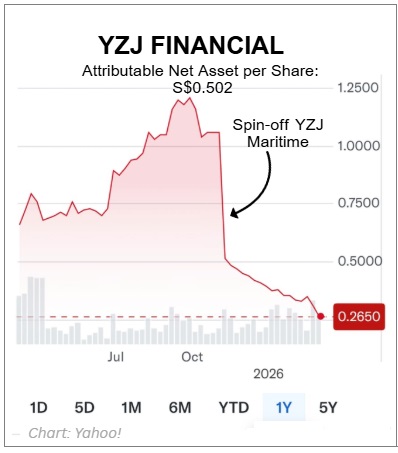
Ms Liu highlighted that the company held S$638.2 million in cash and cash equivalents as of Dec 31, 2025.
When combining the cash with the remaining S$1.1 billion in performing debt and equity investments, the total NTA sits at S$0.50 per share.
With the stock trading at roughly $0.27, the market was valuing the company at a 46% discount to its book value.
| Analyst Q&A: Focus on China Recovery and Yield |
The Q&A session was dominated by two themes: the timeline for recovering the remaining China debt and the company’s plan to restore dividend payouts.
On China Debt Exposure and Property Market Stress
Analysts questioned the "stickiness" of the remaining China debt portfolio, which has now been reduced to roughly 27% of AUM.
They asked whether the current provisions represent the "bottom" of the cycle.
Management's reply:
While the property sector in China remains under pressure, the company’s remaining exposures are "backed by sufficient collaterals."
The company is in no rush to fire-sell but is proactively clearing out laggards.
On the 1H 2026 Deployment Strategy and Equity Yields
With the company sitting on a significant cash pile, analysts inquired about the specifics of the planned RMB 1 billion (S$184.3 million) deployment into listed equities.
Management's reply:
“In 1HFY2026, we intend to progressively deploy up to RMB 1 billion into selected listed equities with yields above 4.5%.”
This strategy marks a pivot toward liquidity and income stability.
On Post-Spin-off Sustainability
A recurring question concerned the company's ability to remain "efficient and profitable" with a substantially smaller asset base (NTA fell from ~S$1.17 to S$0.50 per share post-distribution).
Management's reply:
By stripping out the capital-intensive maritime assets, the "new" YZJ Financial can achieve better Return on Equity by cultivating new growth in Singapore and the broader region.
Ms Liu stressed that the company's dividend policy remains intact. The company is committed to a 40% payout ratio. To support ongoing shareholder returns, it intends to always keep 20% of its portfolio in cash specifically earmarked for dividend payouts and potential share buyback. |
 → See Yangzijiang Financial's Powerpoint deck here.


