

|
Tai Sin Electric’s FY2026 (ended June) results delivered a disappointing contrast: revenue jumped 24.2% to S$597.2 million, but profit before tax tumbled 57.1% to S$13.3 million. |
Tai Sin's growth is broader than the headline suggests.
Its newly acquired Renewable Energy Solutions business in Thailand contributed S$59.8 million of revenue over eight months.
This was supported by strong residential solar demand following government tax incentives to encourage rooftop solar adoption.
Importantly, Group revenue still grew 11.8% excluding this addition.
CGS estimates core profit attributable to shareholders rose 27% to S$32.8 million after excluding exceptional items.
Prime Asia’s segment analysis also shows resilience: stripping out FY2026 provisions and FY2025 provision reversals, Cable & Wire pretax profit increased from S$23.3 million to S$28.1 million.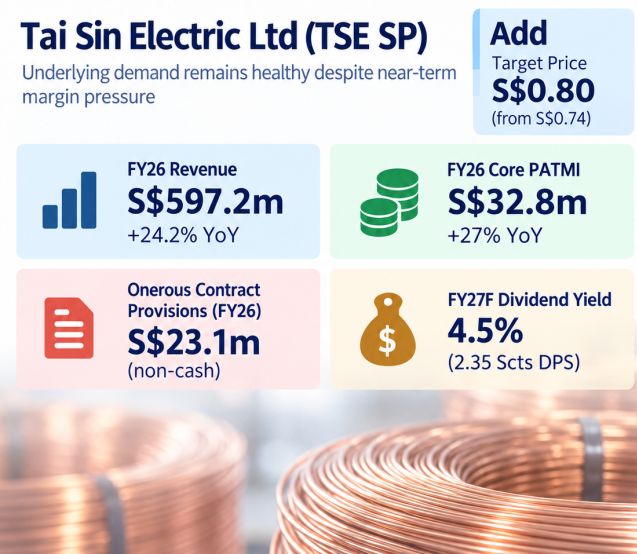
| The weaknesses |
Tai Sin booked S$23.1 million of onerous-contract provisions, reflecting higher copper costs on existing fixed-price cable orders.
| Reversal of provisions? |
| "Consequently, lower copper prices could trigger partial reversals of TSE’s c.S$23m provisions, which could serve as a share price catalyst." -- CGS International |
Although non-cash when recognised, these provisions flag expected contract losses.
Even excluding provisions, CGS notes that gross margin softened, mainly because of changes in sales mix.
Nor was every business thriving. Test & Inspection revenue fell 3.9% to S$28.8 million and it recorded a S$0.2 million pretax loss.
There is also a funding burden. Prime Asia highlights thin operating margins and substantial inventory and receivables requirements.
CGS puts FY2026 net gearing at 32.5%, versus 24.9% a year earlier.
Growing sales can therefore absorb cash rather than immediately strengthen the balance sheet.
| Copper divides the analysts |
CGS expects copper to ease from around US$14,400 per tonne to an FY2027 average of US$12,800, citing high exchange inventories and softer Chinese demand.
That could allow partial provision reversals.
|
TAI SIN ELECTRIC |
|
|
Share price: |
Target: |
Prime Asia is more cautious.
It expects copper to remain elevated and warns of further provisions in the first half of FY2027.
Its argument: inventory accumulating in the US ahead of possible tariffs does not necessarily ease availability elsewhere.
Still, Prime Asia sees a potential eventual benefit from higher—but more stable—copper prices, once cable repricing catches up.
| Promising pipeline, with conditions attached |
Both reports identify opportunities in data centres, electrification and infrastructure.
Prime Asia highlights Changi Terminal 5 and MRT projects, while treating Western Island and Long Island as longer-term opportunities.
While Prime Asia doesn't specify a target price, CGS retains its “Add” rating, raising its target price to 80 cents, based on 10 times FY2028 earnings.
At its 52.5-cent reference price, forecast annual dividends of 2.35 cents imply a 4.5% yield.
CGS’s projected 13% annualised core EPS growth over FY2025–FY2028 includes the strong FY2026 increase.
Its forecasts imply more modest growth of 5.5% in FY2027 and 6.8% in FY2028.
Tai Sin has credible growth opportunities, but the investment case depends on margins and cash conversion—not merely rising sales.
"Reiterate Add as we believe TSE is currently enjoying multiple tailwinds (ASEAN DC rollout, Singapore construction boom, etc.), supporting its FY25-28F core EPS CAGR of 13%."Prime Asia's Head of Investment Advisory, Irvine Chiam: "Tai Sin Electric is currently valued as a traditional electrical-products manufacturer.... Yet its earnings exposure is increasingly shifting towards structural growth areas including electrification, data centres, grid infrastructure and renewable energy across Singapore/ASEAN, suggesting that the market may be underappreciating the quality and growth potential of its evolving earnings mix." In the meantime, the final dividend of S$0.016 per share (interim: S$0.0075) suggests the Group has a pretty stable dividend policy. |

 → See also:TAI SIN ELECTRIC: First Analyst Coverage for This Stock Riding on Construction, Data Centre Tailwinds


