

|
AEM’s latest results: stronger profits, a bigger order backlog and evidence that customers are upgrading equipment already installed. At the 3Q results briefing, CEO Samer Kabbani said: “This is an execution story that turns customer demand into financial performance."
A S$7.8 million tax credit boosted reported earnings. Using AEM’s adjusted net margin, underlying quarterly profit works out to approximately S$34.8 million — about 34% above CGS International’s pre-results forecast of S$26 million. |
The 9M2026 picture:
|
Metric |
9M2026 |
Comparison / Notes |
|
Revenue |
S$452.1M |
+57.2% vs 9M2025; 9M2025 revenue: S$287.5M |
|
Earnings per share |
22.9¢ |
20.5¢ excluding non-recurring tax credit benefit |
|
Profit before tax (PBT) |
S$82.2M |
13.3x 9M2025 PBT of S$6.2M |
|
Profit after tax (PAT) |
S$73.4M |
S$65.6M excluding non-recurring tax credit benefit of S$7.8M |
|
PBT margin |
18.2% |
Driven by higher volumes, more favorable revenue mix, and operating leverage |
|
PAT margin |
16.2% |
14.5% adjusted excluding non-recurring tax credit benefit |
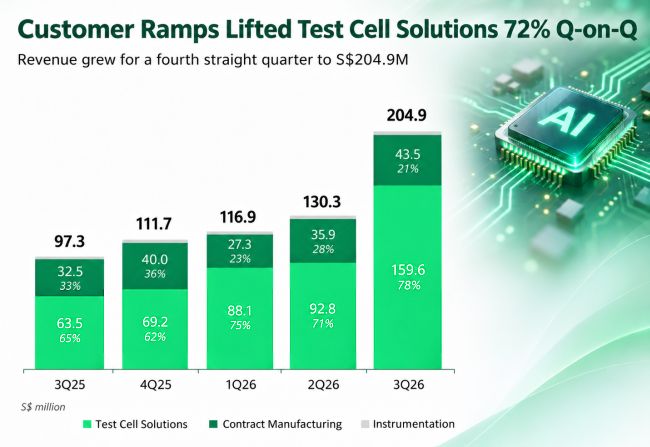 Test Cell Solutions is AEM’s main business segment for its semiconductor test equipment.
| The “razor blades” are already selling |
The most revealing exchange concerned AEM’s “razor-and-razorblade” model.
The idea is that AEM first sells the main test platform (‘the razor’), then earns follow-on sales from chip-specific modules and upgrades (‘the blades’).
These components adapt the testing machine to particular chips, allowing customers to change its capabilities without replacing the entire platform.
Sales of these “configurables and collaterals” reached S$116.2 million, representing 72.8% of Test Cell Solutions revenue.
But that is not AEM’s recurring-revenue percentage. Most current demand involves equipping newly installed systems.
Asked when customers would start upgrading existing equipment, Kabbani replied:
“It’s happening as we speak. Our configurables are a combination of brand-new products and upgrades.”
He added: “At the moment, we have a combination of both—we are refreshing while we’re deploying.”
Upgrades already contribute, although their share is undisclosed.
Customers reuse existing components whenever possible; bigger changes in chip power, size or testing requirements can trigger replacements.
This is repeat business linked to changing chip designs—not an automatic replacement cycle.
| Better margins, without a promise |
Adjusted net margin reached 17%, up from 12.6% in the second quarter.
 CFO Kwek You CheerCFO Kwek You Cheer attributed this to both operating leverage and a better business mix: sales rose faster than costs, while Test Cell Solutions contributed more revenue.
Asked whether customers bringing forward orders had helped profitability, Kabbani said there was no such unusual event explaining the gross-margin improvement.
Kwek nevertheless warned against extrapolating one quarter: “Yes, it may be strong, and it would take a couple of quarters to see how that will sustain.”
| Bigger orders, clearer visibility |
AEM raised full-year revenue guidance to S$680 million–S$705 million, from S$630 million–S$680 million. EPS guidance increased to 30–33 cents, from 24.5–27.5 cents.
Kwek said that guidance excludes the tax credit that was booked in Q3 so as to focus on underlying profitability.
The midpoint earnings increase is about 21%, against roughly 6% for revenue. AEM expects to earn more from each dollar of sales.
The growth is coming from both major customers: its PC/foundry customer (Intel) and its fabless AI/HPC customer (widely speculated to be AMD) —a chip designer that outsources manufacturing. HPC stands for high-performance computing, including powerful processors used in AI servers and data centres.
Kabbani stressed that server processors, rather than ordinary laptops and desktops, drive the markets AEM primarily serves:
“Both customers are supply-constrained; they both have significant demand they can’t satisfy.”
AMPS, AEM’s platform for stress-testing advanced chips, had a backlog exceeding S$450 million on 11 Nov, versus over S$400 million in August.
Kwek supplied a delivery timetable: “We expect this to ship over the next two to two-and-a-half quarters.”
Kabbani clarified that the backlog covers AMPS alone, excluding AEM’s other platforms.
|
Metric |
Previous |
Revised / Latest |
Remarks |
|
FY2026 revenue guidance |
S$630m–S$680m |
S$680m–S$705m |
Guidance raised for third time in 2026 |
|
FY2026 EPS guidance |
24.5–27.5 cents |
30–33 cents |
Excludes S$7.8m tax credit |
|
AMPS backlog |
Over S$400m (12 Aug 2026) |
Over S$450m (11 Nov 2026) |
Orders across customers |
Source: AEM Holdings' 3Q2026 Investor Update, 11 Nov 2026
The midpoint of revenue guidance increased 5.7%, while the midpoint of EPS guidance increased 21.2%, indicating stronger expected profitability.
Kabbani said AEM is pursuing large cloud operators’ custom-chip testing through ASE (a major company specialising in chip packaging and testing) and its PC/foundry partner. “I think we’re progressing well on both fronts,” he said, while acknowledging long sales cycles. Memory is behind schedule. Qualification of AEM’s Xact memory-testing handler is now projected to finish by 1H2027.
Cash deserves watching -- It fell to S$69 million while inventory and receivables increased. Dividends and buybacks accounted for S$10.8 million of outflows, so the decline was not entirely operational. The takeaway: earnings and orders are delivering; upgrades are real. AEM will provide 2027 revenue guidance in February. |
 See the Powerpoint deck here. See also: AEM CEO on “Razor-and-Blades” Model Driving Its AI Test Growth |


