

|
At 62 Singapore cents, Sasseur REIT offers a 10.4% trailing distribution yield.
All borrowings are denominated in renminbi, with the sponsor providing half. |
| Retail performance was less buoyant |
Sasseur's 12 Nov briefing highlighted high occupancy, alongside softer retail spending.
Nine-month outlet sales rose 4.4% to RMB3.39 billion, but third-quarter sales fell 2%.
3Q2026 average occupancy nevertheless improved to 98.6% from 97.2% in the preceding quarter.
The anniversary promotions started later in September and extended into October.
Management said outlet sales from July to 7 October grew slightly year on year. 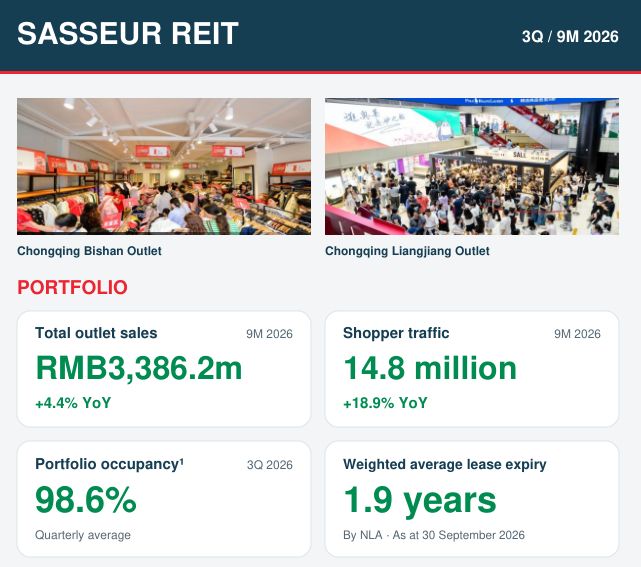
| The renewal that matters |
Sasseur’s entrusted management agreement (EMA) cushion its rental income through a fixed component that rises 3% annually, alongside a variable component linked to outlet sales.
Fixed rent contributed about 71% of nine-month EMA rental income, providing a substantial buffer against fluctuations in tenant sales.
That structure helped nine-month rental income grow 3.4% in renminbi. A stronger Chinese currency lifted the increase to 6.9% in Singapore dollars, reaching S$97.6 million.
The current agreements expire in March 2028.
CEO Cheng Hsing Yuen called the EMA “a foundational pillar of our Sasseur REIT value proposition”, with renewal discussions under way.
He stressed:
“Our priority is to ensure that the renewed EMA framework is as robust and watertight as possible to safeguard the distribution and protect the long-term interests of our unitholders.”
Management is reviewing operational parameters against current market conditions; it has not disclosed an agreed replacement contract or announcement timetable.
| Understanding the manager’s unit sales |
Asked about the manager’s sale of 25 million units across August and September, the CEO gave some context.
Cheng said institutional investors and high-net-worth individuals had approached Sasseur because they wanted to invest.
He emphasised that the interest came from them:
“They reached out to us—not that we reached out to them. They came to us and said they wanted to invest.”
He said these investors had shown keen interest in Sasseur REIT’s platform and outlet business model.
The five transactions by Sasseur Asset Management generated gross proceeds of S$16.85 million for the manager.
It receives part of its management fees in REIT units: for the first half of 2026, 60% of the base fee was paid this way. The remaining 40% was paid in cash by the REIT.
These fees are the manager’s business income, supporting staff salaries and other overheads. Selling units converts that fee income into cash.
Sasseur’s lower financing costs and high occupancy support its income appeal. The main uncertainty is the revised rental framework and its terms -- particularly the fixed rental component, annual escalation and duration of any extension -- after March 2028. |
 See the Powerpoint deck here. See also:Sasseur REIT Breaks Records in Q1: Here’s How They Did It |


