

|
Even as China may grow much more slowly over the next 15 years, several big investment themes could create hugely valuable companies. "Compelling investment themes are emerging alongside the sectors driving China’s long-term growth."China is expected to rely less on imported AI chips and build more of its own semiconductor ecosystem. This should benefit local AI chipmakers and related suppliers. AI itself should also become deeply embedded in business operations. Large cloud and technology platforms could capture much of this value.
Advanced manufacturing will be another major growth area, especially robotics, automation, precision components and the low-altitude economy, such as drones and eVTOL aircraft. Finally, China’s green transition will remain important.
|
| How did DBS pick its Champions? |
DBS constructed a Seven-Pillar Framework, assessing companies on policy alignment, growth trajectory, moat durability, capital efficiency, geopolitical resilience, optionality and execution capacity.
So, it isn't simply chasing the companies with the fastest projected revenue growth.
Moat durability gets the largest weighting at 20%, followed by policy alignment at 18% and growth trajectory at 17%.
DBS explains why:
“Long-term compounding depends on defensible advantage, not sector growth alone.”
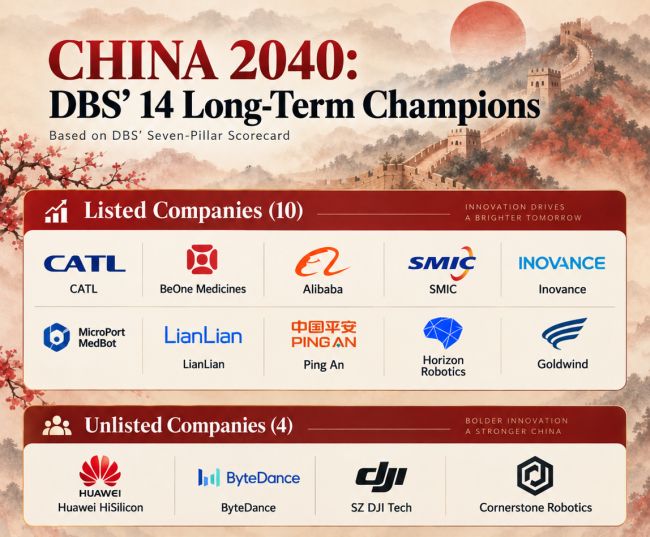
The 3 highest-ranked listed companies are CATL, BeOne Medicines and Alibaba.
|
Seven-Pillar Scorecard of 2040 Champions |
||
|
Company |
Industry |
Weighted Score |
|
CATL |
Energy Storage |
94.0 |
|
BeOne Medicines |
Innovative Drugs |
93.7 |
|
Alibaba |
AI Application |
86.1 |
|
SMIC |
AI Infra & Hardware |
84.7 |
|
Inovance |
Advanced Manufacturing |
82.2 |
|
MicroPort MedBot |
Surgical Robots |
82.1 |
|
LianLian |
Banks & Fintech |
78.6 |
|
Ping An |
Life Insurance |
76.3 |
|
Horizon Robotics |
Electric Vehicles |
76.1 |
|
Goldwind |
Renewables |
69.8 |
|
Huawei HiSilicon (unlisted) |
AI Infra & Hardware |
92.3 |
|
ByteDance (unlisted) |
AI Application |
89.9 |
|
SZ DJI Tech (unlisted) |
Low Altitude Economy |
81.7 |
|
Cornerstone Robotics (unlisted) |
Surgical Robots |
76.1 |
For the full table details, see page 11 of DBS report
| Here's why |
1. CATL: Batteries — but increasingly not just EV batteries
CATL (3750 HK) sits at the top with DBS describing its investment case as an “unshakable market position underpinned by R&D leadership.”
CATL has ranked first globally in EV batteries for nine consecutive years and in energy-storage batteries for five.
DBS expects booming storage requirements from renewable energy, grid upgrades and AI data centres.
It estimates CATL's EV battery volumes could grow 17% annually through 2040, while energy-storage battery volumes grow even faster at 25%.
CATL also enjoys scale, strong R&D, broad patent protection and higher profitability than many competitors.
The catch is geopolitics. Tariffs and localisation rules may require more manufacturing outside China, raising costs.
2. BeOne Medicines: China's biotech goes global
BeOne Medicines (6160 HK) offers an entirely different route into China's innovation story.
Its attraction is what DBS calls a “China-cost/global-revenue structure.”
Much of BeOne's clinical development remains anchored in China, where DBS estimates trials cost 30–40% less than in the US and Europe.
Yet BeOne has built its own commercial operation across the US, Europe and more than 70 countries rather than simply licensing its drugs to Western pharmaceutical companies.
That potentially allows it to combine Chinese R&D economics with Western-market revenues.
It is also better insulated from US-China tensions than many Chinese biotech peers: BeOne has US manufacturing and derives more than half its revenue from the US.
The risks are familiar — clinical failures, regulatory setbacks and the possibility that today's promising pipeline doesn't deliver tomorrow's blockbuster drugs.
3. Alibaba: Can AI become the new profit engine?
Alibaba (9988 HK) is perhaps the most familiar name — but DBS's thesis is increasingly not about e-commerce.
DBS calls Alibaba:
“the clearest listed company through which to monetise AI” in China.
Alibaba combines its own chips, cloud infrastructure, Qwen AI models, enterprise distribution and real-world applications.
And crucially, it already has a cash-generating business capable of funding the enormous investment AI requires.
DBS expects Cloud and AI, just 13% of Alibaba revenue in 2025, to reach 52% by 2040, with cloud overtaking core commerce around 2030.
The risks are intense AI competition, heavy capital spending and continuing regulatory pressures on the consumer-platform business.
DBS itself notes that “policy points in two directions” — supportive towards AI and domestic silicon, but more restrictive towards consumer platforms.
What is striking is that CATL, BeOne and Alibaba operate in completely different industries. What connects them is scale, technology, financial resources, defensible competitive advantages and exposure to long-duration structural growth. At the heart of DBS's China 2040 thesis, they are potential major winners who can turn innovation into enduring profits. |
 For another long-term growth story, see: For another long-term growth story, see:
AEM: Why Jefferies and UBS Set Target Prices $15-16, Say AI Test Boom Has Further to Run |