

|
Uni-Asia Group, at about S$0.925, has a market cap of only about S$73 million, with shares continuing to be at a very large discount to asset value.
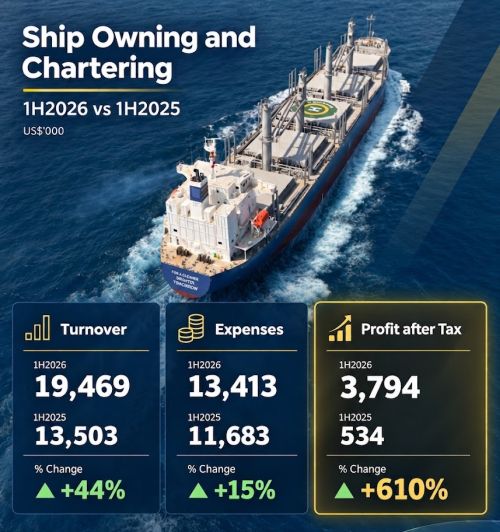
More significantly, the Ship Owning & Chartering segment generated about US$3.79 million after-tax profit, compared with only US$0.53 million in 1H2025. |
| Renewed fleet starts to show earnings power |
Uni-Asia now has nine wholly or majority-owned vessels, all Japanese-built, and management says its already-fixed average charter rate for 2H2026 exceeds US$14,200 per day, excluding index-linked charters.
That gives good visibility into the next six months but five of the nine vessels are due to reprice during 2H2026, leaving meaningful exposure to market rates.
Management said its two index-linked vessels were earning close to US$17,000 a day at the time.
FY2025 was a transition year for the fleet.
Uni-Asia acquired four vessels, disposed of its remaining older 29,000-DWT vessels, and suffered extended off-hire from the damaged MV Glengyle. Charter income consequently fell 15% in FY2025.
In other words, 1H2026 may be the first indication of what the renewed fleet can earn.
Uni-Asia also has a useful pipeline of relatively young vessels from its existing joint-investment structures.Management illustrated the economics using the proposed Uni Harmony acquisition.
A roughly 10-year-old second-hand vessel may cost around US$20–23 million, versus about US$35 million for a comparable newbuild. With 60–70% debt financing, Uni-Asia's equity requirement for a majority stake can be only a few million US dollars.
| Japan property is becoming more interesting |
The Japan property segment swung from a small loss to US$1.15 million profit after tax in 1H2026, while turnover increased 84%.
Management wants to move selected ALERO projects from “develop and sell” towards “develop and hold”, including serviced apartments aimed at longer-stay foreign tenants.
It is also expanding its capital-light asset-management and Private Finance Initiative (PFI) businesses.
Its Japanese asset-management arm had JPY70.5 billion of AUM spanning residential, hospitality, healthcare and PFI (Private Finance Initiative) assets.
Management ultimately wants property to generate around US$4–5 million of annual profit by 2030, helping cushion future shipping downturns.
| Formal dividend policy |
Management has introduced a dividend policy from FY2026 targeting distributions of at least 25% of consolidated profit attributable to shareholders.
| Target: Consistent profitability |
 "Based on discussions with institutional investors, it was observed that the Company’s lack of a consistent track record of profitability remains a key factor affecting its attractiveness to strategic investors, and accordingly, the Company will refocus on its core strengths and continue to revitalise its shipping and property portfolios to enhance overall shareholder value." "Based on discussions with institutional investors, it was observed that the Company’s lack of a consistent track record of profitability remains a key factor affecting its attractiveness to strategic investors, and accordingly, the Company will refocus on its core strengths and continue to revitalise its shipping and property portfolios to enhance overall shareholder value."-- Lim Kai Ching, Executive Director, Uni-Asia Group Source: AGM minutes, 30 April 2026. |
It declared a 1 SG cent interim dividend for 1H2026 (unchanged from 1H2024 and 1H2025).
The stock's valuation is an attraction.
At June 2026, NAV was approximately US$1.64 a share, or about S$2.12 per share. Against S$0.925, Uni-Asia trades at a 56% discount to NAV:
|
Metric |
Valuation |
|
Share price |
S$0.925 |
|
NAV/share |
~S$2.12 |
|
Price/NAV |
0.44x |
|
Discount to NAV |
56% |
Much of the legacy property pain has been recognised: Uni-Asia suffered a tough FY2024 largely because of about US$31 million of non-cash fair-value losses on Hong Kong property investments, resulting in a US$28.2 million group loss.
The affected Hong Kong commercial and industrial property investments were written down to zero following weaker property valuations and credit concerns at the investee companies. They remained at zero in June 2026.
Still, debt remains elevated after the fleet expansion, although it fell by US$4.9m during 1H26. At June 2026, debt was around US$82.6 million, cash US$28.5 million and debt/equity approximately 0.64x.
Loan-to-value was about 47.8%. A fall in vessel values and charter rates would hurt NAV and earnings.
The fleet investment isn't finished. At June 2026 Uni-Asia had US$31.45 million of contracted vessel capital commitments, before taking account of the subsequent second 40,000-dwt newbuild announced in August.
Uni-Asia today continues to be discounted heavily relative to NAV. Investors will look to 2H2026 to confirm if the improving charter market translates into sustained cash profits — and whether Japan property genuinely starts developing into a recurring earnings cushion. |
 → See the 1H2026 PowerPoint deck here


