

|
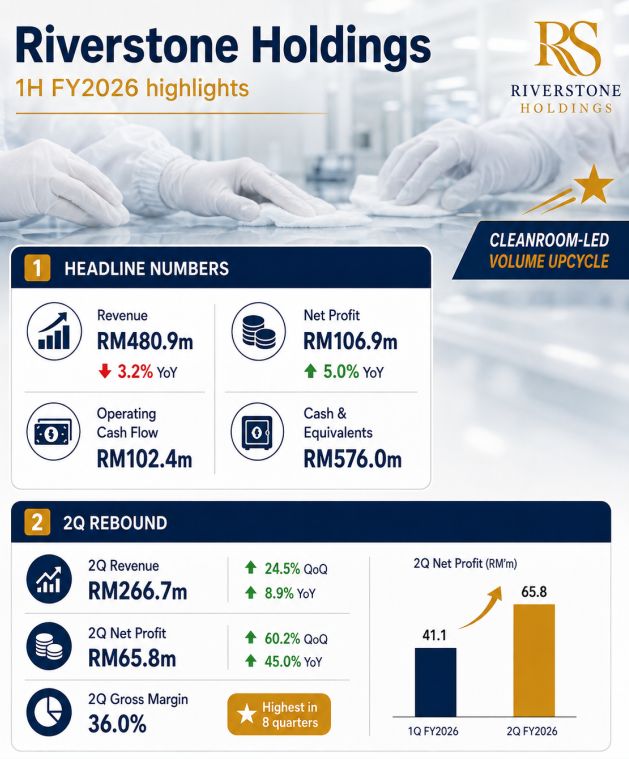
Riverstone Holdings’ 1H2026 results look fairly modest at first glance. Revenue fell 3.2% year-on-year to RM480.9 million, while net profit rose just 5.0% to RM106.9 million. The clear signs of improvement: Revenue jumped 24.5% q-o-q to RM266.7 million, while net profit surged 60.2% to RM65.8 million. |
| Margins are recovering |
Riverstone’s 2Q gross profit reached RM96.0 million, up 54.8% from 1Q, while gross margin expanded seven percentage points to 36.0% — its highest level in eight quarters.
For the whole of 1H2026, gross margin improved to 32.9% from 29.7% a year earlier.
That is significant because the glove industry has spent the past few years battling excess capacity and aggressive price competition.
Riverstone says healthcare glove pricing improved in 2Q, while cleanroom glove pricing remained stable. Higher average selling prices also helped push 1H gross profit up 6.9% despite the decline in revenue.
Management said 2Q healthcare profitability benefited from an unusually favourable gap between selling-price increases and raw-material costs. ASPs have subsequently been adjusted lower as raw-material costs eased.
The star is the cleanroom glove sector, which accounted for 45% of revenue in 2Q but 70% of gross profit.
| AI demand is helping the cleanroom business |
Another interesting takeaway is the strong 2Q recovery was led by its core cleanroom segment, which continues to benefit from AI-driven demand from the data-centre and memory-storage sectors.
This is what differentiates Riverstone from a conventional healthcare glove manufacturer.
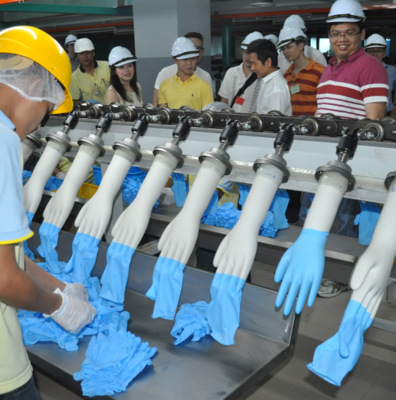
Cleanroom gloves are specialised products used in semiconductor, electronics, disk-drive and other controlled manufacturing environments. They generally face higher qualification requirements and are less commoditised than generic medical examination gloves. CEO Wong Teek Son. File photo
The AI investment and electronics boom therefore gives Riverstone a growth driver that many other glove manufacturers do not have.
Management said demand remains strong and Riverstone is actually struggling to fulfil customer deliveries.
Cleanroom utilisation is around 75%, and the bottleneck is labour-intensive downstream processes such as checking and packing.
Riverstone has therefore resumed hiring foreign workers — around 30–50 had arrived, with roughly another 100 expected — specifically to alleviate the bottleneck.
Thus, 3Q and 4Q volumes should both be higher than 2Q as manpower improves.
The cleanroom gloves business has a high barrier to entry because customer qualification is tedious, specifications keep getting more demanding, products are customised, and Riverstone sells directly to customers.
| Still sitting on a large cash pile |
Riverstone also remains financially strong.
Cash and cash equivalents stood at RM576.0 million at end-June, down from RM630.4 million at end-2025, largely because of dividend payments. The company nevertheless generated RM102.4 million of operating cash flow during the half.
One item worth watching is inventory. It jumped from RM87.3 million at end-2025 to RM142.5 million, which management attributes to higher raw-material prices and increased stocks needed to support production requirements.
UOB Kay Hian increased its target from S$1.10 to S$1.21, using 24x 2027 earnings. It argues that Riverstone's cleanroom moat, net-cash balance sheet and dividend record justify the premium.
While also agreeing that Riverstone deserves a valuation premium over peers’ average of 16x, CGS uses just 19x FY27 earnings for its S$1.00 target.
|
FY26F profit |
FY27F profit |
Target stock price |
|
|
UOB KH |
RM217.9m |
RM230.4m |
S$1.21 |
|
CGS |
RM222.3m |
RM239.9m |
S$1.00 |
Dividend remains attractive: Riverstone declared an interim dividend of 5.0 Malaysian sen per share, representing a payout ratio of 69.3%.
This equates to an annualised yield of around 3.8% based on a share price of S$0.83.
The dividend is slightly below the 5.5 sen interim dividend paid for 1H2025, but the balance sheet leaves considerable room for shareholder returns.
Management continues to flag currency volatility, raw-material costs, and uncertainty surrounding US tariffs. Malaysian gas costs are expected to rise about 50% from October. Management acknowledged that 100% pass-through to customers may not always be achievable. |
 → See also:RIVERSTONE: 100% of profits are paid out, with special dividends covered by "depreciation"


