

|
This article draws on the “Great Bargains” and small-cap investing sections of AGT Partners’ 2Q 2026 Shareholder Letter, which reported +30% return for its fund in 1H2026. AGT Partners is a Singapore fund management company holding a Capital Markets Services licence. It is regulated by the Monetary Authority of Singapore and manages money for accredited and other qualified investors. Its shareholder letters reveal not only what the fund owns, but also how its managers think about valuation, risk, patience, management quality and the prevention of permanent capital loss. |
| What makes a “Great Bargain”? |
A great bargain is not simply a share whose price has fallen.
AGT distinguishes between Great Businesses and Great Bargains.
Great businesses generally possess strong competitive advantages and earn high returns on capital. The AGT fund owns stocks such as DBS, TSMC, Tencent, CNOOC, Sheng Siong, KKR, Apollo, Microsoft and Alphabet.
Great bargains may not enjoy the same exceptional economics, but compensate investors by trading at considerably cheaper valuations.
AGT’s bargain holdings span industries such as oil and gas, shipyards, container shipping, commodities, property and construction.
Because these sectors attract less investor attention than artificial intelligence or other fashionable themes, mispricing can be more common.
But some companies are ignored because they have weak balance sheets, declining businesses or management teams that have repeatedly destroyed shareholder value.
The investor must determine whether the low valuation reflects temporary neglect or permanent deterioration.
| Traits of investees |
| "Each company has a long operating track record, a strong value proposition within its respective industry, and is led by highly experienced founder-management teams with sizeable and, in some cases, increasing ownership." -- AGT Partners, on companies includingOKP, Marco Polo Marine, Nam Cheong and ISOTeam. |
AGT has accumulated stakes of more than 5% in several Singapore-listed companies --- including OKP, Marco Polo Marine, Nam Cheong and ISOTeam.
The fund emphasises that these were not sudden purchases. It followed the companies for years and observed how their founder-managers behaved when business conditions were difficult and capital was scarce.
That is a valuable professional-investing insight. Management quality is easiest to claim during prosperous times.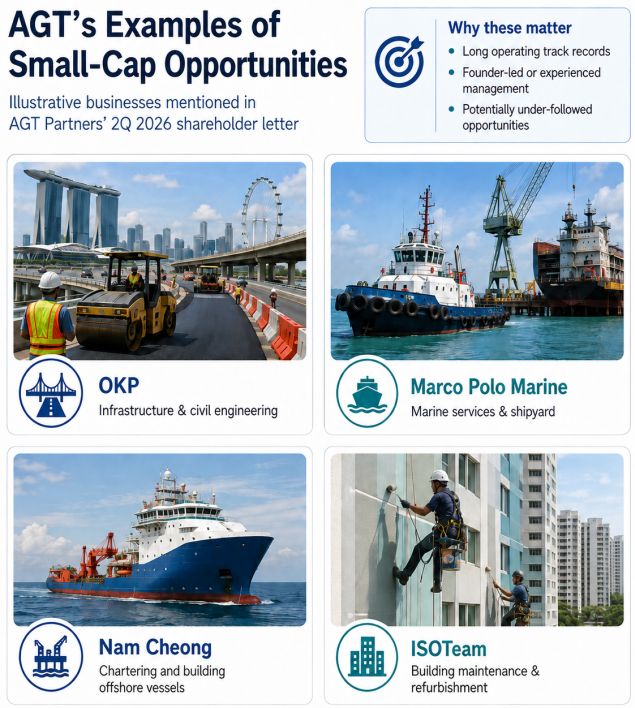 Year-to-date stock return: OKP +5.4%, Marco Polo Marine -19%, Nam Cheong +19%, ISOTeam -10%.
The real test comes in a downturn.
Does management protect the balance sheet? Does it issue new shares at an unnecessarily low price? Does it continue paying itself generously while shareholders suffer? Or does it make difficult decisions that preserve the company’s long-term value?
| Successful investing requires long-term capital |
AGT also makes a distinction investors sometimes overlook: successful long-term investing requires not only patience, but capital that is genuinely able to remain invested.
The letter uses Dyna-Mac as an example. AGT invested when the company’s market capitalisation was about S$350 million, near the bottom of its earnings cycle and at a single-digit price-to-earnings multiple. Its investment approximately doubled during 2024.
The result sounds straightforward in hindsight. The journey was not.
AGT had monitored, accumulated and held the shares for several years while dealing with low liquidity and high volatility.
Many people say they are long-term investors but become uncomfortable when a stock goes nowhere for several months.
That is why AGT stresses the importance of “sticky capital” — funding that can remain invested while management executes its plans and the market gradually recognises the company’s improving economics.
Smaller companies can be mispriced because they receive little analyst coverage and may be too small for major institutional funds. A most useful lesson from AGT’s shareholder letter: the ideal small-cap investment is not merely cheap. It is cheap, financially resilient, competently managed and capable of becoming a better business. |
 → See also:NAM CHEONG: Its CEO on Moats and Margin of Safety, Debt and Discipline


