
• Hong Leong Asia (HLA) has come off its year-to-date $3.50 peak to trade at $2.80 as rising energy costs become a headache for the industrial sector. • However, DBS Group Research says that HLA (market cap: S$2.1 billion) is navigating these choppy waters calmly. • A significant portion of HLA’s workload comes from government-linked projects. These contracts often include variation clauses tied to material price indices, allowing the company to pass cost increases to clients.
• Supported by a strong growth trajectory in its powertrain and building materials segments, DBS maintains a BUY rating on HLA with a target price of $3.90. Read more below .... |
Excerpts from DBS report
Analyst: Dale Lai
Post-conference notes: Rising costs remains a concern but have mostly been passed on
• Overall growth trajectory remains intact, driven by large orderbook and stringent cost management
• Increased reliance on alternative fuels emerging as the key competitive advantage for HLA • Maintain BUY with unchanged TP of SGD3.90, driven by large orderbook and stringent cost management |
|||||
We hosted HLA in our Jewels of Singapore conference held on 27 March 2026 with investors.
Key takeaways:
Powertrain Business
China Yuchai continues to demonstrate strong growth momentum, supported by rising exports, market share gains in China, and robust demand for higher-margin generator products.
Export growth remains a key driver, underpinned by competitive pricing and the use of lower emission standards (National 6), which support better margins.
While domestic demand in China is mixed, the company continues to gain share, aided in part by government incentives encouraging the replacement of older vehicles.
A key earnings driver is the generator segment, particularly used for data centres, where average selling prices can be up to 25 times higher than a typical engine (~RMB50,000).
Although volumes remain relatively small, the significantly higher margins have driven outsized profitability, contributing to the c.60% growth in earnings for China Yuchai last year.
Capacity expansion completed over the past two years is expected to support further growth, with demand for high-horsepower engines and data centre generators remaining strong.
Production capacity for power generators are expected to increase by c.30% this year. The planned Hong Kong listing of the generator business remains in progress (currently at the A1 stage), representing a potential medium-term value unlock.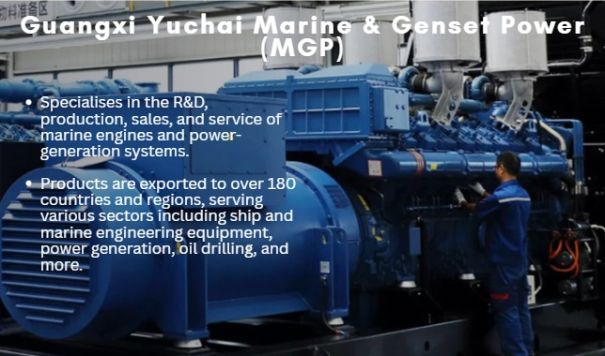 HLA’s 48.7%- owned subsidiary China Yuchai International has announced that its 71.4%-owned subsidiary, Guangxi Yuchai Marine & Genset Power, has filed to list on the Hong Kong Stock Exchange
Building Materials Business
The building materials segment contributes about one-third of revenues and is supported by a strong pipeline of multi-year infrastructure and construction projects, particularly in Singapore.
Demand remains underpinned by sustained HDB construction and a broader mix of public and private developments, with industry billings near record levels.
The precast business continues to benefit from structural HDB demand and improved construction efficiencies, providing multi-year earnings visibility through its orderbookdriven model.
Meanwhile, the ready-mix concrete (RMC) segment is expected to recover, supported by plant reinstatements and improving cement pricing in Malaysia, where liberalised pricing has helped restore margins.
|
Research House |
Target Price |
Rating |
|
CGS International |
$4.50 |
Add |
|
UOB Kay Hian |
$4.71 |
Buy |
|
DBS Group Research |
$3.90 |
Buy |
Cost pressures, particularly from fuel and raw materials, remain elevated, with diesel prices up c.100% and coal up c.50%. However, the impact is largely mitigated through contractual structures. Government-linked projects, which form the majority of the workload, include variation clauses tied to material price indices, allowing most cost increases to be passed through to clients. In addition, vertical integration and procurement strategies, such as locking in steel prices at tender and sourcing materials via HDB, help protect margins. Private sector contracts, however, have less flexibility and may face greater cost absorption. The group is also actively managing energy costs through the increased use of alternative fuels and raw materials, which currently replace about 22% of coal usage, with a target of c.35%. These initiatives not only reduce reliance on traditional energy sources but can also lower costs through the use of waste-derived inputs. |
 → See the DBS report here.
→ See also: HONG LEONG ASIA: Two back-to-back target hikes for this company as data centre angle heats up


