

|
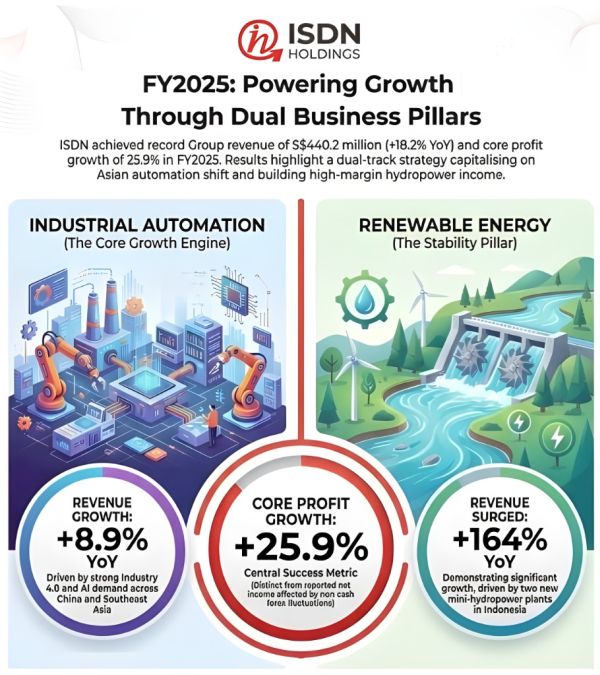
ISDN Holdings has delivered a robust financial performance for FY2025, recording a 25.9% year-on-year increase in S$9.7 million core profit attributable to shareholders. ISDN’s top-line growth was strong, climbing 18.2% YoY to S$440.2 million, driven by resilient performances across its key business segments and geographies. |
The Board proposed a final dividend of 0.53 Singapore cents per share, amounting to a 25% payout ratio.
Forex Losses and Future Reporting
Despite the strong operational momentum, ISDN's as-reported net profit declined by 20.7% to S$6.8 million. 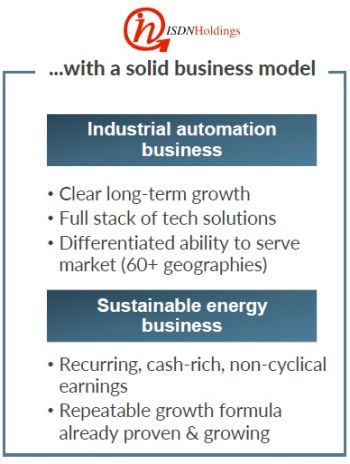 This discrepancy is almost entirely due to S$4.5 million in non-cash, unrealised foreign exchange (forex) revaluation losses.
The company's renewable energy business operates on long-term contracts spanning up to 25 years.
Under this model, long-term receivables and payables are revalued each period.
Because the USD weakened against the SGD and strengthened against the Rupiah during the year, it triggered significant unrealised forex losses on the income statement.
To mitigate this non-operational accounting volatility going forward, ISDN announced a shift in its reporting practices for the renewable energy segment.
MD and President Teo Cher Koon explained, "we are going to change the financial report currency from SGD to USD. So with that, we will not have to worry about the long term unrealized forex loss".
Future long-term unrealised forex fluctuations will be reflected in Other Comprehensive Income (OCI) rather than creating severe swings in the core Profit & Loss statement.
Two Primary Pillars and Growth Drivers
ISDN’s strategy is rooted in two primary pillars: Industrial Automation and Renewable Energy.
1. Industrial Automation -- This core segment delivered an 8.9% YoY revenue increase, driven by a 5.4% growth in China and an 18.3% surge in Southeast Asia.
ISDN's growth drivers are fueled by the rising adoption of Industry 4.0, AI, and the Internet of Things.
Mr. Teo highlighted this demand, noting, "Because of all these environments we need industrial automation software, hardware and the hottest thing right now is AI".
Reflecting on the broader market shift, he noted in the company's earnings release: "FY2025 reflects the underlying structural demand for industrial automation across our core markets. As manufacturers in China and Southeast Asia continue to upgrade capabilities, automation, robotics and AI-enabled solutions are becoming increasingly essential to productivity and competitiveness".
Having strategically invested in talent during the recent downcycle, the company is now primed for returns. "We have already built up a pool of software and hardware engineers," Mr. Teo stated, "It's about time that we expand our market reach and harvest from the market".
|
Semiconductor Backend Equipment: The backend semiconductor equipment sector is expected to "move very fast" and deliver "promising outcomes". The semiconductor sector currently contributes a substantial 25% to 30% to revenue. ISDN continues to actively participate in the semiconductor backend equipment market across both Southeast Asia and China. Data Centers: Although the data center market does not currently contribute much, ISDN is focusing on this highly promising industry. ISDN is actively growing its business and already is providing software solutions and platforms to help major operators manage their data centers more efficiently. Along with smart warehouses, these areas are viewed as the primary verticals where ISDN sees its growth trajectory heading. |

2. Renewable Energy -- Serving as a reliable generator of cash-rich, recurring earnings, the renewable energy segment saw its revenue more than double to S$58.9 million in FY2025.
While ISDN currently operates three mini-hydropower plants in Indonesia, its primary growth driver is capacity expansion.
Two additional mini hydropower plants are scheduled for completion in 2026, increasing total power output by +81%, adding more recurring earnings for the Group.
This expansion secures a much larger, sustainable recurring income base for ISDN for decades to come.
Q: When is ISDN planning to spin off the hydro plants?
Mr Teo: I've just hired a financial guy who has a lot of experience in M&A and in the financial markets, especially in infrastructure. So he's coming on board this month and he will help us to strategize it, structure it so that we can spin it off, you know, at the right time. Q: Will the energy crisis improve the valuation of ISDN's hydro plants? Mr Teo: Valuation should improve because as gas and petroleum become more expensive, hydropower becomes an even more affordable and attractive alternative. Q: How is ISDN's order book so far and for the next six months?
Mr Teo: We are quite happy the order book is actually at least 20-30% higher than the past. We have been seeing this order book for the past few months, since last November. |
 → See also: ISDN: This Company's Core Profit Just +58% -- Don't Get Distracted by Accounting Quirk's Impact


