
• The story of Nam Cheong is becoming a standout in corporate turnarounds. After a grueling four-year trading suspension that began in 2020 due to financial distress, the Malaysian offshore support vessel (OSV) leader has not just returned to the Singapore Exchange — it has thrived. In March 2024, it completed a comprehensive debt restructuring which, unfortunately, was painful for all shareholders as it involved a 100-to-1 share consolidation. Upon relisting, the share price faced investor uncertainty as well as relentless selling by Nam Cheong creditors (banks included) which were paid in shares. In recent months, Nam Cheong’s stock has staged a remarkable rally, hitting a record high of S$1.60 last week -- a staggering climb from its post-relisting low of S$0.12. Key drivers include: A global shortage of OSVs has pushed charter rates higher. 2H2025 saw a 138% jump in PATMI over 1H, fueled by higher vessel utilization. And after a decade-long hiatus, the company secured new shipbuilding contracts, diversifying its revenue. With a declining debt profile and a young fleet, Nam Cheong has transformed from a restructuring story into a high-growth sector leader. • RHB has now joined DBS Research and CGI International in covering the stock and it has the most bullish target:
Read more ..... |
Excerpts from RHB initiation report
Analyst: Syahril Hanafiah
We believe Nam Cheong is well positioned for a multi-year growth phase, supported by stable utilisation thanks to its long-term charter portfolio and a young fleet of 36 vessels.
Recent shipbuilding contract wins in a tight offshore support vessel (OSV) market suggest a potential revival of the shipbuilding segment and additional earnings upside. Our valuation is in line with regional peers, and we forecast a 3-year core earnings CAGR of 15%. |
|||||
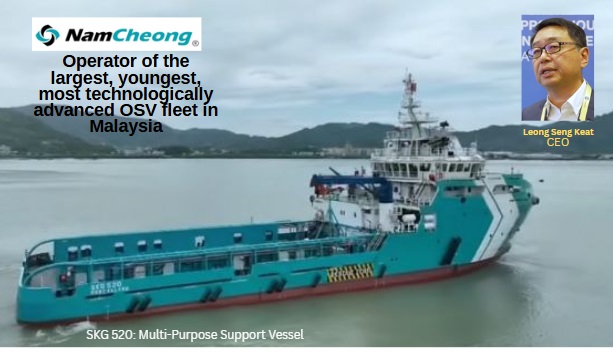
• Young fleet with multi-year chartering contracts. Nam Cheong’s competitive advantage in vessel chartering lies with its young-age fleet averaging nine years – significantly lower than the industry average of 14-16 years.
Its long-term charter contracts also provide earnings visibility, while the remaining vessels on spot charter allow the group to capture any upside during periods of rising charter rates.
• Restoration of interest in newbuilds. In the midst of tight supply, an ageing global OSV fleet, and years of underinvestment in the sector, rising demand for younger vessels is likely to spur a more active resale market and renewed interest in newbuild vessels.
This trend is reflected in the recent sale of multiple young vessels across the industry, on top of new contract wins recently secured by Nam Cheong to deliver four OSVs.
We believe that the growing appetite for younger builds could revitalise activity at Nam Cheong’s Miri shipyard, which has the capacity to build up to 12 vessels per year.
• Strategic Sarawak play amidst PETRONAS-Petros dispute. Regardless of the PETRONAS–Petroleum Sarawak (Petros) dispute outcome, we believe Nam Cheong is unlikely to face material disruption.
Sarawak’s offshore activity is expanding moderately as the state works to open more offshore areas for exploration, supporting sustained OSV demand.
As a Sarawak-based operator, Nam Cheong is naturally aligned with this growth and well positioned for state‑led offshore developments. It also maintains established commercial ties with PETRONAS, with its subsidiary SKOSV holding a valid Petronas licence covering upstream and downstream operations.
With Sarawak’s rising strategic importance and Nam Cheong’s deep regional roots, the group remains well buffered against regulatory uncertainty.
• Other key rerating catalysts include exposure to renewable energy market, ie offshore wind energy, its new geo-tech vessels with a variety of enhanced
features, and accelerated debt repayment that could accelerate through potential future vessel sales, resulting in interest savings.
We project a 3-year core earnings CAGR of 15%, mainly driven by its chartering segment with stable vessel utilisation and charter rates, gradual fleet expansion, and balance sheet deleveraging. Our TP is based on 11x FY27F target P/E, benchmarked vs its regional peers. Key risks: Contract renewal, O&G sector reliance, and capital expenditure. |
 → See RHB report here.
See also: NAM CHEONG: After a 63% year-to-date surge, what will drive this marine stock further?


